Scroll through productivity TikTok, a freelancer Discord, or a LinkedIn thread right now and you will bump into a strange little word: woeken. For example, people post about locked-in mornings and distraction-free afternoons, then drop the term like everyone should already know it. However, nobody explains it, which only makes it spread faster.
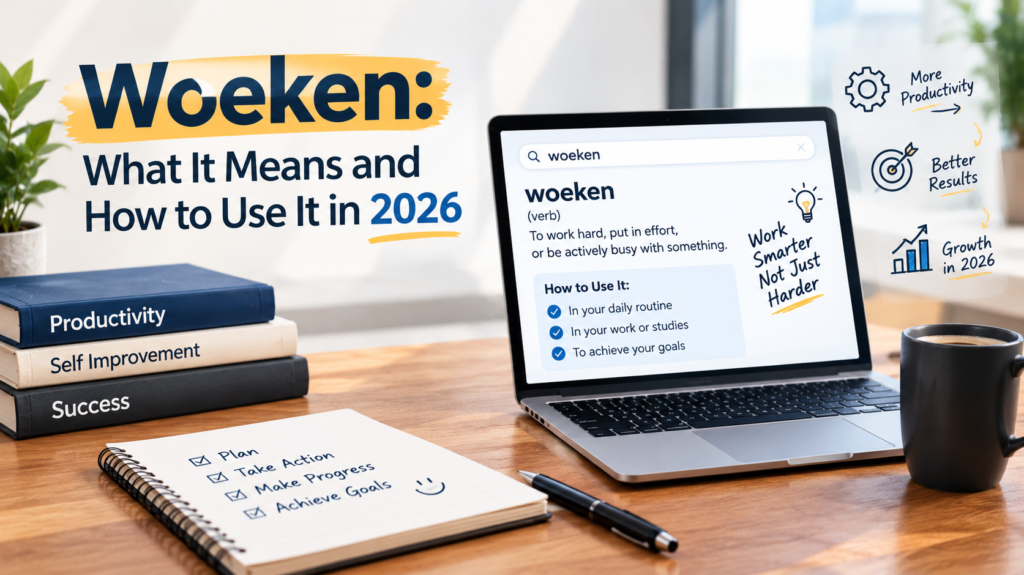
In fact, it is an invented internet word with no dictionary definition. It has no official meaning, and that absence is exactly why it took off. As a result, people have filled the gap with three main uses: a deep-work sprint, a playful slang term, and a brand-friendly name. This guide covers all three, traces where the word likely came from, and shows you how to turn the productivity version into a real routine. Whether you are a student, a freelancer, or just curious, you will leave knowing exactly what everyone is talking about. It is also a useful case study in how internet language works: a strange sound appears, thousands of people assign it jobs, and within months it feels like it was always there.
Quick Facts
Point | Details |
|---|---|
Word type | Invented internet term, no dictionary entry |
Pronunciation | WOO-ken (two syllables, stress on the first) |
Main uses | Deep-work sessions, casual slang, brand and username material |
Likely roots | Dutch-sounding, related to “woekeren” (to proliferate) |
Who uses it | Freelancers, students, remote workers, creators |
Best for | Naming focused work blocks and building a personal routine |
What Does Woeken Mean?
Specifically, three interpretations dominate across social platforms, and most people blend them without thinking twice.
1. A deep-work sprint
This is the most common use. The term means a block of concentrated, distraction-free work. Phones off, tabs closed, one task at a time. For instance, someone might announce they need three solid hours of it to finish a report, and everyone understands the subtext: do not disturb, real work happening.
It functions as a friendlier alternative to phrases like “deep work” or “monk mode.” In contrast, those sound corporate or extreme. This one sounds like something a friend would say over coffee, which explains why freelancers and students adopted it first. Consequently, the casual tone lowers the barrier: you do not need a productivity system to start, just a timer and an intention.
2. Playful slang
The second use is lighter. Here the word becomes a vibe label for anything done with intention, productive or not. For example, a slow weekend morning with coffee and a journal can be described with it. It also works self-deprecatingly, as in claiming a focus session while actually scrolling through videos. Indeed, the joke lands because everyone recognizes the gap between planned focus and actual behavior, and naming it takes away its power.
3. A brand-ready name
Commercial use is the third interpretation. The word is short, easy to pronounce, and nearly empty on search engines, which makes it attractive for usernames, newsletters, templates, and small businesses. Moreover, a productivity-flavored name with zero baggage is rare. Search interest in woeken as a brand term keeps climbing as creators rush to claim handles, domains, and newsletter titles before the space fills up. As a result, early adopters get the memorable handles while latecomers settle for numbers and underscores.
Where Did the Word Woeken Come From?
Honesty first: nobody knows for certain. The word has the rounded sound of Dutch, where “oe” makes an “oo” sound, as in boek (book) or zoeken (to search). Therefore, that Dutch flavor is probably why it feels familiar to European ears and fresh to everyone else.
The closest real Dutch relative is “woekeren,” a verb meaning to proliferate or spread aggressively, like weeds taking over a garden or costs spiraling out of control. Its noun cousin “woeker” can even mean usury, or exploitative financial gain. In other words, the literal Dutch neighborhood is not exactly peaceful productivity.
That gap is the interesting part. It shows what the internet did: borrowed the sound and invented a new meaning. Online, the term has almost nothing to do with aggressive spreading. Instead, it means focused, intentional effort. In fact, languages evolve this way all the time, with old sounds getting fresh jobs. Just know that if you use it with a Dutch speaker, they may hear something closer to “rampant growth” than “calm focus.” Nevertheless, context does the heavy lifting, as it always does with slang.
Most likely, the word surfaced in late 2025 inside a small online community, perhaps a productivity Discord server or a TikTok comment section, and spread because it filled a real gap. English had no casual, friendly word for “I am about to focus hard.” Now it does. Furthermore, the timing lined up with a broader burnout backlash that made people hungry for healthier ways to talk about work.
How to Run Your First Woeken Session
To begin with, here is how to turn the word into a working routine. The method below borrows from research on ultradian rhythms, which suggests the brain focuses best in roughly 90-minute cycles.
Set up the session
- Pick one task. Not three, not “catch up on everything.” Instead, write the single outcome on paper or a sticky note where you can see it.
- Set a timer for 90 minutes. Shorter works too; 25 or 50 minutes is fine while you build the habit. The timer is your boundary.
- Remove the exits. Phone in another room or on airplane mode, unnecessary tabs closed, notifications silenced. Every removal is a gift to your future self.
Work the session
- Start with a two-minute warm-up. Reread your notes, open the document, arrange your desk. Rituals tell your brain that focus time has begun.
- Work until the timer ends. Meanwhile, when distractions pop up, jot them on a side list and return to the task. The list handles the anxiety of forgetting.
- Take a real break. Walk, stretch, get water. In other words, do not swap work scrolling for phone scrolling.
Close the session
- Debrief for five minutes. Note what worked, what broke your focus, and what you finished. This short review compounds into a much better routine within weeks.
Therefore, repeat this three to four times a week and the word starts working like a switch. Tell the people around you that a session is starting, and the phrase itself becomes a boundary they learn to respect.
For example, a bad 90 minutes usually comes down to one of three things: the task was too vague, the environment had too many exits, or you were simply exhausted. Shrink a vague task to make it concrete. Remove one more distraction from the environment. And meet exhaustion with rest, not guilt. In short, the method works when you troubleshoot it like an experiment instead of judging yourself.
This Method vs Other Focus Approaches
Method | Core idea | Session length | Best for |
|---|---|---|---|
Focus sprints (this approach) | Intentional deep-work block with a ritual | 25 to 90 minutes | Freelancers, students, anyone wanting a friendly routine |
Pomodoro | Timed intervals with short breaks | 25 minutes work, 5 rest | Beginners who need structure |
Deep work (Cal Newport) | Long distraction-free cognitively demanding work | 1 to 4 hours | Knowledge workers with big projects |
Flow state | Losing track of time in an engaging task | Unplanned | Creative work that pulls you in |
Monk mode | Extreme elimination of distractions for days | Days to weeks | Short intense pushes, like launches |
In contrast, this approach sits in the friendly middle. It is less rigid than Pomodoro, less demanding than monk mode, and more social than silent deep work. Furthermore, you can even combine methods: run Pomodoro timers inside a longer session, or treat the daily block as your standing deep-work appointment.
The Other Side: Rest Counts Too
A newer branch of the conversation uses the term to mean intentional recovery, not just output. The argument goes like this: most of what we call rest is not restful. For instance, scrolling and binge-watching leave people more drained, so they never actually recharge.
Intentional rest flips that. Instead, it means treating recovery with the same seriousness as a work block: a walk without podcasts, an afternoon with no screens, a full day where nothing is optimized. Some creators now talk about “rest sessions” as the counterpart to “work sessions,” two halves of one rhythm.
This matters because the word’s biggest risk is becoming another hustle badge. Pairing it with deliberate rest keeps it honest. Focus hard first. Then recover fully. The people who sustain high output for years all learn this eventually, usually the hard way. If you take one idea from this guide, take this pairing: deep focus plus deliberate recovery beats endless grinding every time.
Criticisms Worth Hearing
Not everyone loves the trend, and the objections deserve airtime. The sharpest criticism is that the term romanticizes overwork by giving grind culture a cute new name. Consequently, if the word becomes pressure to always be “on,” it has failed at its own premise.
A second concern is vagueness. A word that means everything can end up meaning nothing, which makes it useless as advice. In fact, telling someone to “just focus harder” in fancier language helps nobody.
Both criticisms point to the same fix: keep the practice concrete. A timed session with one task, no distractions, and a real break afterward is a genuine technique. On the other hand, a mindset with no boundaries is just hustle with better branding. Use the ritual, skip the identity.
Frequently Asked Questions
What does woeken mean?
It is an invented internet word with three common uses: a focused deep-work session, a playful slang term for intentional activity, and a brand-friendly name. Indeed, there is no official dictionary definition.
Is it a real Dutch word?
Not exactly. It sounds Dutch and resembles “woekeren” (to proliferate or spread aggressively), but the internet meaning of focused work is newly invented. However, a Dutch speaker may hear something closer to rampant growth.
How do you pronounce it?
WOO-ken, with the stress on the first syllable and the “oe” sounding like the “oo” in “book.”
How long should a session be?
Start with 25 to 50 minutes if you are new to focused work. Next, build toward 90-minute sessions, which match the brain’s natural focus cycles. Always end with a real break.
Can I use it as a brand name?
Many creators already do, for newsletters, templates, and usernames. Therefore, check trademark databases and domain availability first, since short catchy words get claimed fast.
Is it just another hustle-culture buzzword?
It can become one if used carelessly. The version worth keeping is concrete: a timed session, one task, no distractions, real rest after. That is a technique, not an identity.
Final Thoughts
Woeken began as a sound with no meaning and became a tool for naming something real: the decision to focus. Moreover, whether you use it for deep-work sprints, as lighthearted slang, or as the name of your next project, the word works because it is yours to define.
The version that lasts will be the practical one. Pick a task, set a timer, clear the distractions, and rest when you are done. Do that consistently and the term will mean something solid in your life, whatever the internet decides it means next. Still, trends fade, but the underlying skill of choosing focus on purpose never goes out of style.
If this guide cleared things up, share it with the friend who keeps asking about the word. Every trend needs one good explainer, and now you have it.
You may also Like: Almawadahit Com USA: Honest Guide to the Tech Blog