
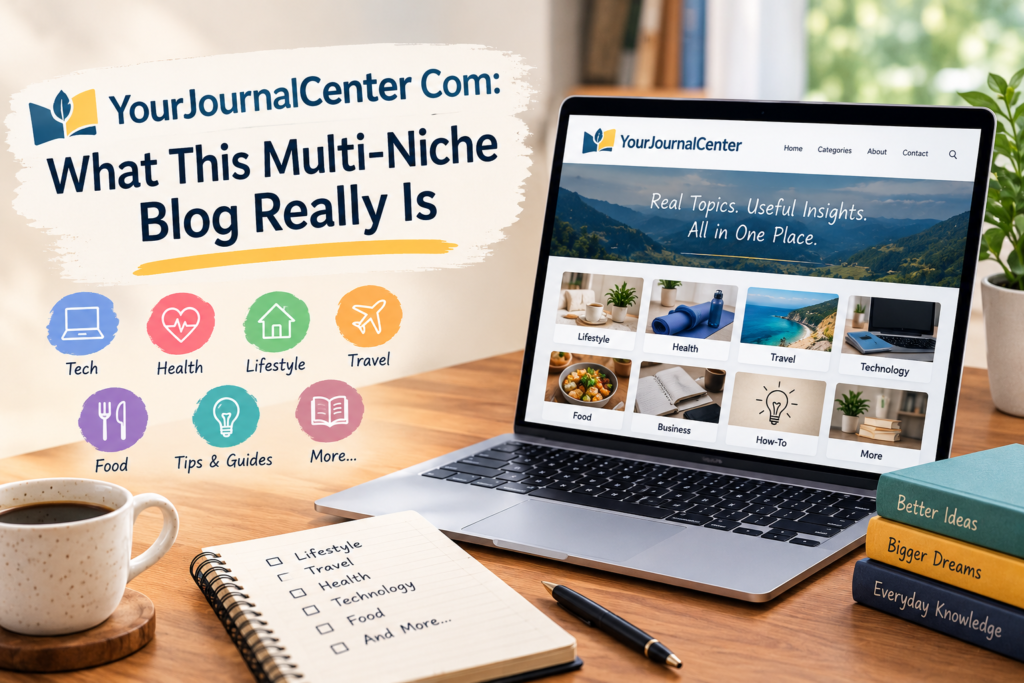
If you searched for this name expecting a digital diary, you can stop looking. Yourjournalcenter com is a general-interest content blog that publishes articles on finance, education, travel, pets, technology, and cars, among other topics. It is not an app, and it has no notebook, mood tracker, or prompts. This guide explains what the site actually offers, so you can decide in a few minutes whether it deserves a spot in your reading routine.
What Yourjournalcenter Com Really Is
The site brands itself with the tagline “World News, Business, Tech & Lifestyle.” Its homepage description calls it a news and media platform covering business, technology, health, education, lifestyle, entertainment, and world affairs. That is a wide promise. In practice, the site works more like a blog or content hub than a traditional newsroom.
The navigation bar currently lists ten categories: Automotive, Business, Education, Fashion, Finance, General, Health, Lifestyle, Technology, and Travel. Pets also appears in the sidebar category list. Earlier descriptions of the site mention a smaller set, such as Finance, Education, Travel, General, Pets, Technology, and Automotive. The newer labels suggest the site has widened its menu over time.
The niche focus is, honestly, no single niche. That is the point of a multi-topic blog. One day’s post might cover trading basics, and the next might cover pet nutrition or shade tents.
The site runs on WordPress with a ready-made blog theme. That tells you it is a lightweight publishing setup, not a custom media platform.
Now the timeline. The domain is reported as registered in July 2023. The archive, however, lists posts dated as early as March and April 2023. That gap is common when older content gets imported or backdated, so treat the exact launch date with a little caution.
Posting activity is real but uneven. The archive shows articles in nine different months between March 2023 and October 2025. The newest post I could find was dated October 27, 2025. There are long quiet stretches, so this is not a daily news operation.
Clearing Up the Confusion
Some articles ranking for this name describe the site as a journaling or reflective-practice resource. They talk about writing prompts, self-reflection, and mindful habits. That framing is wrong.
The likely cause is simple. The word “journal” sits in the name, and many readers connect it with diaries. Writers who never opened the site may have guessed from the name alone. Search results then repeat the guess, and the myth spreads.
Here is what you will not find on the site:
- No account sign-up for private entries
- No daily prompts or gratitude lists
- No mood or habit tracking
- No downloadable journal templates or planners
What you will find is a feed of articles. In that sense, “journal” is used in the older newspaper sense, as in a periodical or publication. Think of the name as closer to “daily paper” than “personal diary.”
If you actually want a journaling tool, look at dedicated apps or a plain paper notebook. Day One and similar apps are built for that job. This site is built for reading, not writing about yourself.
A second misconception is worth clearing up as well. Some pages describe the site with vague phrases like “clean layouts” and “seamless user experience.” Those lines say nothing useful. The site is a standard blog with a post list, a category menu, and a search box. That is fine, but it is not a revolution in design.
Homepage and Category Walkthrough
Here is what a US visitor sees on arrival. The page opens with a simple header showing the site name, followed by the category menu. Below that sits a section labeled “Blog,” which lists recent posts as a vertical feed. Each entry shows a category tag, a headline, a date, and a short excerpt.
Page one holds nine posts. Pagination runs to six pages in total, so the visible archive is modest. You could skim the whole thing in an afternoon.
The sidebar offers a search box, recent posts, an archive by month, and the category list. The footer links to About, Editorial Policy, Privacy Policy, DMCA, Terms and Conditions, Disclaimer, and Contact pages. Social links point to Facebook and LinkedIn. The presence of an editorial policy page is a good sign for transparency, even if it does not guarantee quality.
Next, consider the actual content. A sample of recent headlines shows the range:
- Finance: “Top CFD Trading Strategies That Beginners Can Try” (October 2025) and “Using Short-Term Corporate Loans for Cash Flow Management: Smart or Risky?” (July 2025)
- Education: a piece on building an interior design career through online courses and certifications, and one on data science training in Bangalore
- Travel: tips for planning a sustainable vacation, plus a comparison of 10×10 canopy tents
- Pets: “Homemade Pet Food: Is It Safe and Nutritionally Balanced?” (June 2025)
- Technology: an explainer on plotter paper
- Automotive: a post about a car services business, dated August 2023
Notice what is missing. Despite the “World News” tagline, the front page shows no breaking news, political coverage, or wire reports. The content leans toward evergreen explainers and service-style articles. Some read like promotional or commercial pieces, such as the custom gazebo article aimed at Australia.
For US readers, that matters. A few posts target audiences abroad. CFD trading is also generally not open to US retail traders, so that guide has limited practical use here. Always check whether a topic applies to your state or country.
Who Should Read It and Who Should Not
This site suits a particular kind of reader. It is not for everyone, and that is okay.
Good fit:
- Casual readers who like browsing mixed topics without a firm goal
- Small business owners curious about cash flow, branding, or event gear
- Students and career changers looking for general introductions to fields like design or data science
- Pet owners who want a starting point before talking to a veterinarian
- Anyone who enjoys short explainers on everyday, practical questions
Poor fit:
- Readers who want breaking US or global news. Stick with established outlets like the Associated Press, Reuters, or your local paper.
- Investors seeking regulated, personalized financial guidance. A blog post cannot replace a licensed advisor.
- Parents or pet owners making health decisions. Use the articles as background, then confirm with a doctor or vet.
- Journaling fans hoping for prompts or a writing space. Again, this is not that kind of site.
- Researchers who need peer-reviewed or primary sources. Blog posts rarely meet that standard.
A simple rule works well here. Use the site for light, general reading. For decisions involving money, health, or safety, go to a credentialed source.
Strengths and Honest Limitations
Every site has trade-offs. Here is a balanced view of this one.
Strengths
First, the range is broad. A casual reader can bounce from a travel tip to a pet question to a tech explainer in one sitting. That variety appeals to people who do not want to follow a single beat.
Second, the posts are easy to read. Headlines are plain, and many pieces use a how-to or “what is” format. You do not need background knowledge to follow along.
Third, the site is simple to navigate. Categories are visible at the top, the archive is short, and the policy pages are one click away.
Fourth, the site discloses basic information. An editorial policy, a disclaimer, and a contact page give readers somewhere to turn with questions.
Limitations
On the other hand, a ten-category site spreads thin. Search engines and readers tend to trust sites that go deep on one subject. A blog that covers pets, cars, finance, and tents cannot easily build that kind of topical authority.
In addition, traffic appears modest. The comment section on the homepage reads “No comments to show,” which suggests low reader interaction. Low engagement does not mean low quality, but it does mean a small community.
Likewise, the publishing rhythm is irregular. Months pass with no new posts, so you cannot count on fresh content.
Moreover, some articles feel promotional or aimed at foreign markets. US readers may find a few pieces irrelevant or thin on verifiable detail. Few posts cite named sources, data, or expert quotes, which weakens trust on serious topics.
Finally, the news label overpromises. The tagline says “World News,” yet the feed reads like a lifestyle and business blog. Set your expectations accordingly.
Comparison Table: Verified Facts vs. Common Mistakes
The table below compares what the site actually shows with the errors in some of the articles ranking for this name. The competitor descriptions reflect the common weaknesses of those pages: the journaling myth, empty generalities, and keyword-stuffed filler.
| Topic | What the site actually shows | What weaker ranking articles get wrong |
|---|---|---|
| Type of site | General-interest content blog | Described as a journaling or reflective-practice tool |
| Tagline | “World News, Business, Tech & Lifestyle” | Often ignored or never quoted |
| Categories | Ten listed in the menu, including Finance, Education, Travel, Pets, Technology, and Automotive | Vague talk of “diverse topics” with no names |
| Platform | WordPress blog with a standard theme | Praise for “clean layouts” with no evidence |
| Domain age | Reported as registered July 2023; archive shows posts from early 2023 | No dates at all |
| Posting activity | Irregular, with the latest visible post in October 2025 | Implied daily or constant updates |
| Features | Articles, search, archives, policy pages | Invented tools such as prompts and trackers |
| Best use | Casual reading on everyday topics | Presented as a self-improvement resource |
Frequently Asked Questions
Is yourjournalcenter.com a journaling app?
No. It has no writing tools, prompts, or private entries. It is a blog that publishes articles on mixed topics.
What topics does it cover?
The menu lists Automotive, Business, Education, Fashion, Finance, General, Health, Lifestyle, Technology, and Travel. Pets appears in the category list as well.
Is it a real news outlet?
Not in the traditional sense. The tagline mentions world news, but the content looks like evergreen blog posts. For breaking US news, rely on established newsrooms.
How often does it publish?
Not on a steady schedule. Posts appear in clusters, with gaps of weeks or months. The newest one I found was dated October 27, 2025.
Can I trust the financial or pet advice?
Treat it as general background only. Money and health choices should involve a licensed financial professional or a veterinarian. Always check claims against official or expert sources.
Is the content written for American readers?
Partly. Some posts are neutral, but others target places like Australia or India. Check each article’s focus before applying the advice in the US.
Can I contact the site or submit content?
The footer links to a Contact Us page, along with About and Editorial Policy pages. Read those first if you have a question or a pitch.
Conclusion
Yourjournalcenter com is a modest, multi-topic blog, and the journaling label simply does not fit. It offers short, readable explainers across categories like finance, education, travel, pets, tech, and cars. Its breadth is its main appeal, and its lack of depth is its main weakness.
For US readers, the smart approach is easy. Browse it for casual ideas and quick introductions. Then verify anything important with trusted, specialized sources. Used that way, yourjournalcenter.com can be a pleasant side stop, as long as you know what you are actually getting.
You may also Like: Yonochomp Com: Is It Legit? What the Site Really Shows


Pingback: BetterThisFacts Tips From BetterThisWorld: Real or Hype?
Pingback: PedroVazPaulo IT Consulting: Is It Legit? 8 Sites Compared