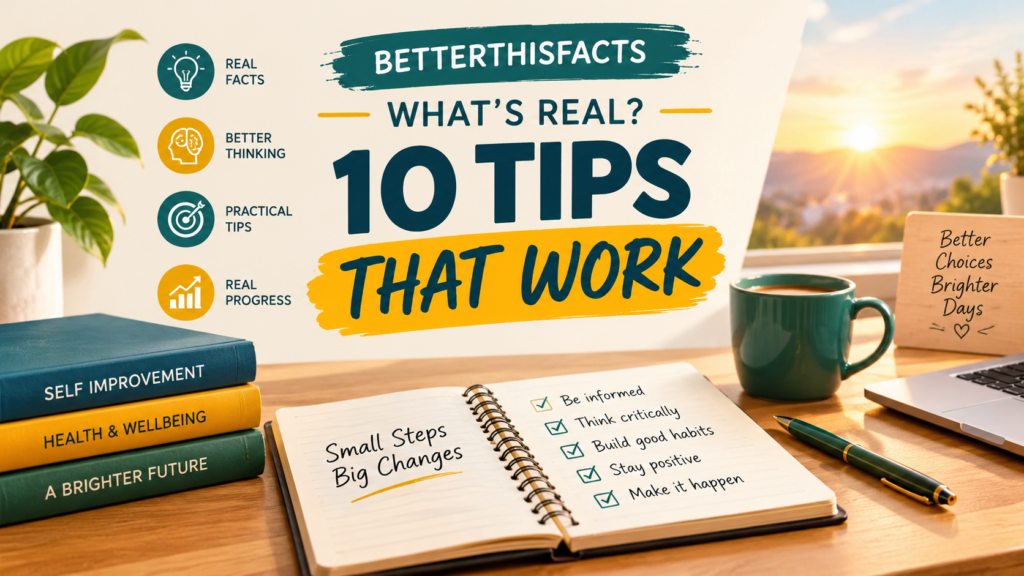
You searched for betterthisfacts tips from betterthisworld and found a pile of pages that all say the same thing. Start small. Drink water. Skip your phone in the morning. The advice sounds fine, yet nobody tells you where it comes from.
This guide fixes that. It explains what the phrase really points to, credits the real sources behind the tips, and gives you ten ideas worth using today.
What Are BetterThisFacts Tips From BetterThisWorld?
Short answer: a phrase, not a program. It appears on many websites, and each one defines it a little differently. None of the guides reviewed names an author, a book, an app, or a study behind it.
| Claim | Where It Appears | What Doesn’t Add Up |
|---|---|---|
| An information hub with verified, evidence-based facts | One explainer | It cites no sources and leans on anecdotes |
| A style of content “inspired by” the brand | One guide | It admits there’s no defined program |
| A workflow for verifying and sharing facts | An article on betterthisworld.com | That’s a different topic from habit tips |
| Productivity and fun-learning tips | Another article on the same site | A second definition on the same domain |
| Proven strategies for daily life | Several guides | No research is named |
The mismatch on betterthisworld.com stands out. Its own articles give two different meanings for the same phrase. As a result, you can’t treat the name as one clear method.
Why So Many Sites Share the Same Phrase
Search results show a cluster of near-identical names. They include ittbetterthisworld.org, itbetterthisworld.org, betterthatworld.org, and betterthisfactstips sites. Most of their guides recycle the same advice, such as small wins, short focus sprints, and tidy spaces.
This pattern is common. A phrase starts to rank, and many sites publish their own version to catch the traffic. Each version borrows from the others. Therefore, repetition starts to look like proof, even though no new evidence appears.
Where These Tips Really Come From
Most tips in these guides are older ideas with known origins. The guides rarely credit them.
| Tip in the Guides | Real Origin |
|---|---|
| The two-minute rule | David Allen’s Getting Things Done: do a task now if it takes under two minutes. James Clear later used a habit version: start any new habit with a two-minute action. |
| 25 minutes of focus, then a 5-minute break | The Pomodoro Technique by Francesco Cirillo |
| Sorting tasks by urgent versus important | The Eisenhower Matrix |
| Attaching a new habit to an old one | Habit stacking, popularized by behavior-change writers such as B.J. Fogg and James Clear |
| Tiny daily improvements | The marginal gains idea, linked to cycling coach Dave Brailsford and popularized by James Clear |
Knowing the source helps you. You can read the original ideas, see the reasoning, and judge them yourself.
10 Tips From These Guides That Actually Hold Up
- Shrink the first step. Make the habit so small it feels silly. Put on your running shoes. Read one page.
- Stack habits. Attach the new action to something you already do. After your morning coffee, write your top three tasks.
- Plan in ten minutes. Pick three priorities, not ten. A short plan beats a perfect one.
- Work in focus sprints. Try 25 minutes on, 5 minutes off. If that feels short, test 50 and 10.
- Sort by urgent and important. Do important tasks first. Drop or delegate the rest.
- Track one number. Choose pages read, minutes focused, or money saved. One metric keeps tracking simple.
- Clear your workspace. Some lab research suggests visual clutter competes for attention. A tidy desk costs little to try.
- Use a simple money rule. Spend less than you earn, and move a fixed amount to savings first.
- Review weekly. Spend five minutes each Sunday on what worked and what didn’t.
- Change one thing at a time. Add a second habit only after the first one sticks.
Claims to Treat With Caution
Several claims in the top guides need a closer look:
- “Evidence-based” with no evidence. Some guides promise research-backed tips, then offer stories about “Sarah” or “one of my clients.” Stories aren’t studies.
- Exact water amounts on waking. Water is harmless, but strong evidence for a specific amount is thin.
- “Most people peak two to four hours after waking.” Timing varies. Some people focus best in the evening.
- Phone-free first hour. It helps many people, yet the evidence is mixed. Test it for a week and judge your own results.
- Diet and supplement advice. One guide lists fasting plans and supplements. Ask a qualified clinician before you try any of that.
How to Spot Recycled Self-Help Content
- Look for a named author. Real experts show their credentials.
- Check for sources. Good guides link to studies or books.
- Compare two pages. If both use the same lines, one probably copied the other.
- Watch for anecdotes. Unnamed clients prove nothing.
- Test before you trust. Try one tip for two weeks and measure the result.
Frequently Asked Questions
What are betterthisfacts tips from betterthisworld?
They’re a search phrase for general self-improvement advice. No single verified program, author, or study stands behind the name.
Is BetterThisWorld a real website?
A site at betterthisworld.com publishes articles under this phrase. However, its own articles define the term in different ways.
Are the tips evidence-based?
Some underlying ideas have research behind them, such as habit stacking and focus sprints. The guides themselves rarely cite studies.
Who created them?
No source names a creator. Most tips come from older, well-known productivity methods.
Do I need an app or a paid plan?
No. Every tip above works with a notebook and a timer.
Final Thoughts
Betterthisfacts tips from betterthisworld works better as a label than as a method. The advice behind it is sound, but it’s borrowed from known sources, and the guides rarely say so. The brand claims are vague, and the “evidence-based” label often rests on anecdotes.
If you came here after searching betterthisfacts tips from betterthisworld, take what works and skip the hype. Pick one tip from the list, run it for two weeks, and track the result. Small, tested changes beat any catchy name.
You may also Like: Yourjournalcenter Com: What This Multi-Niche Blog Really Is