
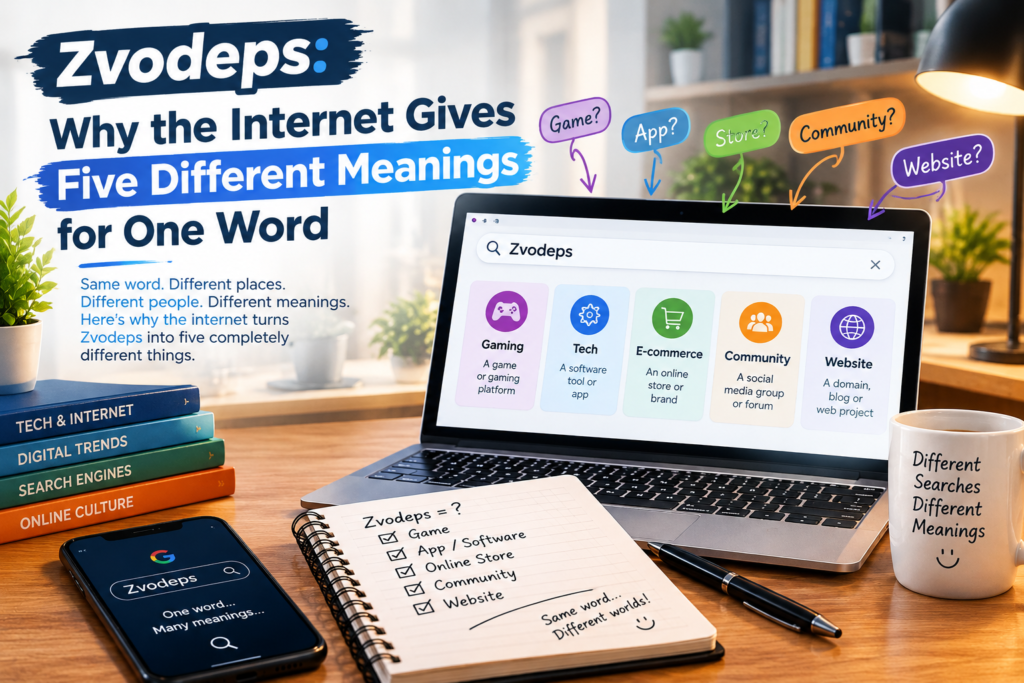
Search zvodeps and you’ll find a wall of confident guides. One calls it a creativity framework. Another calls it a workflow platform. A third describes it as a way to map digital infrastructure. Yet none of them can point to an inventor, a company, or a dictionary entry.
This article lays the claims side by side. It also explains why the term spreads so easily, and it shows you how to treat any guide that uses it.
What Does Zvodeps Mean? Five Answers, No Source
The honest starting point is simple. Several guides admit that no official definition exists. One says the word has no dictionary entry. Another calls it a conceptual term that circulates in tech communities. A third says it grew organically on small blogs and forums, with no company or tech giant behind it.
Even so, the guides keep giving firm definitions. Those definitions don’t match.
| Claimed Meaning | Where It Appears | What Doesn’t Add Up |
|---|---|---|
| Creativity framework that blends planning with spontaneity | Several blog guides | No author, method, or research is cited |
| Adaptive workflow platform for teams | A site at zvodeps.net | The text reviewed names no company or price |
| Dependency intelligence framework for digital systems | A site at zvodeps.us | Describes software engineering, a different field from the guides above |
| Personal growth or identity model | Scattered mentions | Same word, unrelated idea |
| A news website | One line on the .us page | Contradicts the page’s own infrastructure definition |
Notice the pattern. A creativity method, an infrastructure tool, and a news site share nothing except the spelling.
Is Zvodeps a Real Tool or Company?
In the material reviewed, no evidence supports that. One guide states plainly that the term is not an app, tool, or company. Another lists dashboards, tracking, and integrations as if a product existed. Both claims can’t be right.
Look at what a real product leaves behind. It has a company name, a founder, a download page or login, and a price. Support documents and independent reviews follow. For this term, the sources reviewed show none of those. Instead, you find FAQs that answer every question smoothly and cite nothing.
Some guides even compare the word with Notion and Trello. One claims it outshines Notion. That claim can’t be tested, because there’s nothing to download or try.
Quality problems point the same way. At least one article contains broken sentences and stray filler fragments. That often signals automated rewriting.
Why a Coined Term Spreads So Fast
A fresh, unusual word faces no competition in search results. Writers notice that gap and rush to fill it. Each new article borrows ideas from earlier ones, then adds its own twist. As a result, definitions multiply, and the word starts to look established.
Vague language also helps. Phrases like flexible, adaptive, and balances structure with freedom fit almost any work habit. They sound meaningful, yet nobody can prove them wrong.
Even the origin story varies. Some guides say the term appeared in 2025. Others give no date. None names a person who coined it.
How to Handle Terms Like This
A few quick checks protect you from invented frameworks:
- Search a dictionary or academic database. A real concept usually appears somewhere reliable.
- Look for a named creator or company. It should have a working website and contact details.
- Test the product. Check whether you can download, log in, or buy anything.
- Compare two guides. If their definitions clash, assume neither one is verified.
- Watch for big promises. Be wary of guides that claim results without evidence.
Should You Use Zvodeps in Your Work?
There’s no harm in borrowing an idea. Balancing planning with flexibility is sound advice, and methods like Agile have encouraged it for years. However, don’t pay for anything sold under this name. Likewise, don’t cite it as an established method in a report or a pitch. When a team needs structure, proven options such as Agile or Kanban boards serve you better.
Frequently Asked Questions
What is zvodeps?
It’s a word that guides apply to several unrelated ideas. The sources reviewed show no official definition or verified origin.
Is it software?
Some sites present it as a platform. The text reviewed shows no company, price, or download to confirm that.
Who created it?
No source names a creator. Some say it appeared in 2025 on blogs and forums.
Is it safe to pay for?
Avoid paying for any product sold under this name until a real company, clear terms, and independent reviews exist.
Final Thoughts
Zvodeps works better as a case study than as a method. Five guides give five meanings, and none provides a source, a creator, or a product you can test. The confident tone hides how little stands behind the word.
If you meet zvodeps in a blog post or a sales pitch, pause. Ask who made it, where it lives, and what it costs. If nobody can answer, treat the word as marketing language, not a method.
You may also Like: Game Update Befitnatic: What’s Real, What’s Not, and How to Check


Pingback: Yonochomp Com: Is It Legit? Real Facts, Safety & Red Flags